





A few years ago, I got a frantic call from a client named David. His 78-year-old father had suffered a scary slip on wet ceramic tile in the bathroom—a space that, up until that afternoon, the family had considered completely safe. When I arrived to inspect the bathroom, David looked defeated and confessed, “I thought adding a basic plastic stool from the local department store would be enough.”
In my ten-plus years as a home improvement and accessibility renovation specialist, I’ve seen this exact scenario play out more times than I care to admit. According to the CDC, over 80% of bathroom injuries in older adults are caused by falls, and the shower stall is ground zero. People often treat accessibility equipment as an afterthought, picking up flimsily constructed furniture that fails under dynamic weight loads or slick conditions.
Integrating a properly engineered shower chair senior solution into your bathroom layout isn’t an admission of aging—it’s a proactive, high-yield engineering upgrade that preserves independence, restores dignity, and mitigates life-altering fall risks. Let’s break down how to choose, size, and strategically position the ideal seating system for maximum safety and comfort.
The Physics of Bathroom Safety: Load Distribution and Friction Mechanics
To understand why a cheap plastic stool fails, you have to look at the physics of a wet shower floor. When an individual sits down or stands up in a slick environment, they aren’t just applying static downward force—they are generating lateral torque (side-to-side movement) and dynamic load spikes.
Think of a specialized seating unit like a performance off-road tire on an icy highway. If the tire tread lacks deep drainage channels or the rubber compound hardens in wet conditions, the vehicle hydroplanes instantly. A high-spec shower chair senior design uses non-marking, suction-style rubber feet paired with an engineered aluminum frame to cut through soapy water film and lock onto the tile surface.
                  [ Dynamic Weight Load / User Torque ]
                                    ||
                                    \/
========================================================================
|   Blow-Molded High-Density Polyethylene (HDPE) Seat with Drain Holes  |
========================================================================
         /                                                \
        /  Anodized Aluminum Frame (Rust-Proof / Lightweight) \
       /                                                    \
+----------------+                                    +----------------+
| Suction Feet A | <--- [ Soap & Water Film ] --->    | Suction Feet B |
+----------------+                                    +----------------+
========================================================================
                    Substrate: Glazed Ceramic / Porcelain Tile
To maintain structural integrity under continuous moisture exposure, pay close attention to these core mechanical features:
-
Anodized Aluminum Framing: Prevents internal frame oxidation (rust) while maintaining an ultra-lightweight profile for easy repositioning.
-
Drainage Hole Matrix: Prevents standing water accumulation on the seat surface, eliminating soap-scum hydroplaning risks.
-
Cross-Braced Support Rails: Distributes lateral shifting forces evenly across all four legs to prevent structural twisting or leg bowing.
Choosing the Right Form Factor for Your Shower Layout
Bathrooms come in all shapes and sizes, from tight $3\times3$-foot alcove stalls to expansive walk-in wet rooms. Matching your seat architecture to your spatial constraints and user mobility needs is crucial.
| Chair Form Factor | Spatial Footprint | Primary Mobility Benefit | Best Bathroom Configuration |
| Freestanding Four-Leg Chair | Compact ($18″\times20″$) | Portable, height-adjustable, lightweight | Standard shower stalls & walk-in showers |
| Sliding Transfer Bench | Wide ($30″\times22″$) | Eliminates stepping over tub walls completely | Standard bathtub / shower combinations |
| Wall-Mounted Fold-Down Seat | Space-Saving ($16″\times18″$) | Flushes against wall when not in use | Shared multi-generational family bathrooms |
1. Freestanding Height-Adjustable Chairs
These versatile units feature push-button telescopic legs that allow custom height adjustments in 1-inch increments.
-
Best used for: Dedicated shower stalls where the user can step over a low curb independently.
-
Features to look for: Removable padded armrests that give leverage when pushing up to a standing position, and a textured backrest for lumbar support.
2. Heavy-Duty Sliding Transfer Benches
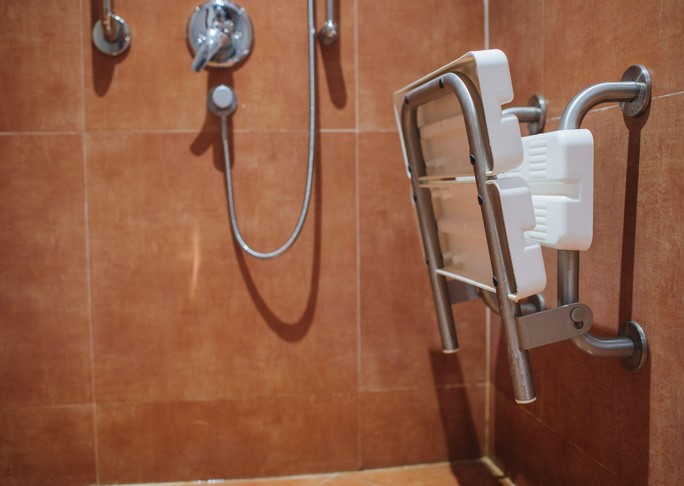
A transfer bench spans over the edge of a bathtub, allowing the user to sit down on the outside of the tub and safely slide their legs over the wall while seated.
-
Best used for: Individuals with severe balance issues or limited hip mobility who cannot safely clear a traditional bathtub wall.
-
Material considerations: Look for smooth-gliding aluminum tracks with dual-locking mechanisms to prevent unwanted movement during mid-transfer.
Step-by-Step Installation & Ergonomic Protocol
Setting up a shower chair senior system requires precision sizing and floor preparation. Here is the exact field protocol I follow when setting up accessible bathing environments for clients.
Step 1: Calculate Proper Ergonomic Seat Height
Adjusting the seat height correctly reduces knee joint stress by up to 40%. Measure from the back of the user’s knee down to the floor while they are sitting in a standard chair with their feet flat. Set the chair height so their knees sit at a clean $90^\circ$ angle, with feet firmly planted on the shower floor.
Step 2: Surface Decontamination and Leg Calibration
Thoroughly scrub the shower floor tile with a non-abrasive degreaser to remove soap scum, hair conditioners, and mineral deposits. Before placing the chair, ensure all four leg-adjustment pins click firmly into the exact same notch level. An uneven leg setting creates frame instability and accelerates leg wear.
Step 3: Verify Four-Point Suction Contact
Place the chair inside the stall and apply firm downward pressure on each corner to lock the rubber suction feet onto the tile. Avoid placing the feet directly over deep grout lines, as air gaps prevent the rubber feet from forming a tight vacuum seal.
[ Step 1: Ergonomic Sizing ]         [ Step 2: Tile Preparation ]
  Measure floor-to-popliteal           Clean soap scum & align pins
+------------------------------+     +------------------------------+
| Target: $90^\circ$ knee bend | ==> | Clear grout lines & ensure   |
| Feet flat on shower floor    |     | 100% rubber suction contact  |
+------------------------------+     +------------------------------+
Pro Tips
Pro Tip: Pair Seating with ADA-Compliant Grab Bars
A chair alone only solves half the safety equation. Standing up from a seated position requires upper-body leverage. Always pair your seating setup with at least one wall-mounted, ADA-compliant grab bar anchored directly into wall studs. Never let anyone use a handheld shower wand slider bar or towel rack as a leverage support!
The Textured Tile Trap
Many modern walk-in showers use heavily textured pebble tile or small 1-inch mosaic tiles. While great for overall foot traction, these uneven surfaces prevent suction feet from creating a vacuum seal. If your shower has pebble flooring, select a model with wider, flat-bottomed, high-durometer rubber feet rather than suction-style cups to prevent rocking.
Reclaiming Independence in the Home
Creating an accessible home isn’t about transforming a warm living space into a cold clinical facility—it’s about using smart design to eliminate hidden hazards. Specifying an engineered, properly fitted shower chair senior setup provides immediate peace of mind, allowing aging family members to maintain their daily personal hygiene routines with complete confidence and comfort.
Are you currently evaluating or retrofitting a bathroom for an elderly family member? Have you run into challenges with tight shower stalls, slippery floor tiles, or improper seat sizing? Drop your questions and setup photos in the comments below—I’d be glad to help you troubleshoot your layout!

+ There are no comments
Add yours