





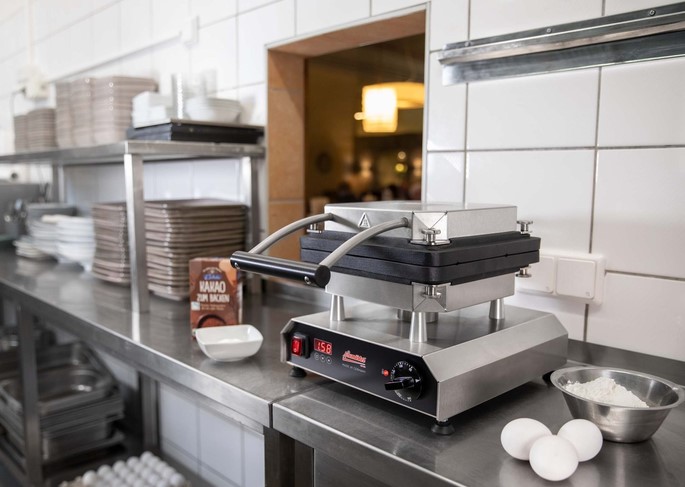
It is 8:15 AM on a Sunday morning. The ticket printer in your kitchen is spewing out breakfast orders continuously, the prep station is overflowing, and the front-of-house line is snaking out the door. In the middle of this chaos, a cook drops a delicate batch of pancake batter onto a flat top griddle, taking up prime real estate for six long minutes while trying to achieve an even golden crust without burning the center.
I have stood in those exact kitchen boots during commercial galley build-outs and residential kitchen redesigns over the last decade. Early in my career while consulting on a boutique bed-and-breakfast kitchen overhaul, I watched a talented chef battle throughput bottlenecks every weekend. The solution wasn’t a $10,000 flat-top upgrade—it was integrating a commercial-grade waffle maker iron into the workflow.
Whether you are scaling up a commercial food service operation or optimizing a high-volume residential kitchen setup, understanding the engineering and thermal efficiency of a dedicated waffle iron can revolutionize your output speed, consistency, and menu versatility.
Thermal Engineering: Why the Waffle Iron Outperforms the Flat Top
To appreciate why a waffle maker iron is a powerhouse of culinary efficiency, you must look at thermodynamic heat transfer. A standard griddle relies on single-sided conductive heat transfer. You pour batter, wait for heat to travel upward through the wet mixture, flip it, and repeat.
A dual-plate waffle iron operates on simultaneous dual-contact thermal conduction combined with pressurized steam pocketing.
[ Batter Placed in Grid ] ➔ [ Dual-Plate Closure ] ➔ [ $360^\circ$ Dual-Contact Conduction ]
                                                                   │
[ Crisp, Fluffy Result ] ◄── [ Rapid Thermal Expansion & Steam ] ◄┘
Think of a high-performance waffle iron like an internal combustion engine cylinder. By compressing batter between two heated plates featuring recessed grid pockets, you drastically increase the surface-area-to-volume ratio.
-
Accelerated Maillard Reaction: The expanded surface area maximizes carbohydrate and amino acid rearrangement, producing a perfectly golden, crispy exterior in half the time of a flat griddle.
-
Rapid Moisture Evaporation: Steam escapes through the grid channels, lifting the batter internally while searing the outer crust.
-
Consistent Yields: Digital temperature controls and timer relays eliminate guesswork, ensuring every cook on your line produces an identical product regardless of skill level.
Heavy Duty vs. Standard Light Units: Selecting Your Engine
Integrating the right waffle maker iron into your station requires matching grid geometry, plate material, and rotation mechanics to your daily volume targets.
| Specification / Feature | Commercial Rotary (Flip) Iron | Fixed Double-Plate Iron | Light-Duty Residential Unit |
| Primary Plate Material | Cast Iron or Non-Stick Cast Aluminum | Cast Aluminum / PTFE Coating | Stamped Aluminum with Non-Stick |
| Output Capacity | 20 – 35 Waffles / Hour | 15 – 25 Waffles / Hour | 4 – 8 Waffles / Hour |
| Rotation Mechanism | $180^\circ$ Continuous Axial Flip | Static Parallel Closure | Static Latch Closure |
| Thermal Recovery Time | Rapid ($<30$ Seconds) | Moderate (1 – 2 Minutes) | Slow ($>3$ Minutes) |
| Best Application | High-Volume Breakfast & Catering | Moderate Cafes & Off-Grid Prep | Occasional Home Use |
The Power of the $180^\circ$ Rotary Mechanism
If high throughput is your goal, a rotary waffle maker iron is non-negotiable. Gravity causes raw batter to pool at the bottom plate when poured. By immediately rotating the unit $180^\circ$, gravity pulls the expanding batter into the upper plate grid, creating uniform thickness, crispness, and density on both sides.
Beyond Breakfast: Unlocking High-Margin Menu Scaling
One of the biggest mistakes kitchen managers make is treating a waffle iron as a single-use tool. In modern kitchen design, multi-functionality is the key to maximizing square-footage profitability.
-
Savory Applications: Hash brown grids, falafel waffles, mac-and-cheese crusts, and pressed panini-style waffle sandwiches utilize existing prep ingredients while creating high-value menu items.
-
Pre-Bake and Flash-Freeze Workflows: Industrial waffle irons allow kitchens to batch-cook hundreds of units during off-peak hours. These can be flash-frozen and reheated in a conveyor toaster within 45 seconds during rush periods with zero degradation in texture.
Expert Advice: Pro Tips & Hidden Pitfalls
PRO TIP: The “Oil-Polymerization” Maintenance SecretNever wash commercial cast-iron or heavy cast-aluminum waffle plates with harsh dish soaps or abrasive metal scrubbers. Treating your iron like fine cast-iron cookware yields a lifetime non-stick surface. Wipe the plates down while warm using a soft bristle brush and high-smoke-point oil (like avocado or canola oil) to build a natural, non-stick polymerized oil coating.
Hidden Pitfalls to Avoid:
-
Using Low-Smoke-Point Spray Oils: Aerosol cooking sprays contain lecithin and low-smoke propellants that burn quickly at high temperatures ($>200^{\circ}\text{C}$). Over time, these additives leave a gummy, dark residue that ruins non-stick surfaces and ruins waffle taste. Brush on pure oils instead.
-
Overfilling the Reservoir: Overfilling leads to batter spilling over side channels, burning onto heating elements, and shorting out internal thermostat sensors. Calibrate your line cooks using precise volume ladles.
-
Ignoring Thermal Recovery Lag: Pouring fresh batter into a plate that hasn’t fully recovered its operating temperature results in soggy, pale waffles that stick to the grid. Always wait for the “ready” thermal indicator light before loading the next batch.
Streamline Your Kitchen Operations Today
Scaling kitchen efficiency isn’t always about knocking down walls or adding massive exhaust hoods. Often, it comes down to integrating smart, compact, thermally efficient equipment that multiplies your line staff’s output.
Investing in a robust, commercial-grade waffle maker iron unlocks rapid cook times, flawless quality control, and exciting menu flexibility that drives real profitability.
What menu items or workflow challenges are currently slowing down your kitchen line during peak hours? Have you experimented with savory waffle iron applications? Share your experiences or questions in the comments below—let’s optimize your culinary setup together!









+ There are no comments
Add yours