




You are in the middle of preparing a large weekend feast. The stove is hot, three pans are sizzling, and you need to fill a massive 24-quart stockpot with water. You lug the heavy stainless steel pot over to the sink, fill it to the brim, and turn around. Now comes the hard part: balancing 50 pounds of sloshing, freezing water across a slick, high-traffic kitchen floor, praying you don’t trip, throw out your back, or spill it all over your footwear.
If this culinary obstacle course sounds exhausting, you are experiencing the primary bottleneck of traditional kitchen workflows.
Over my ten years as a home improvement expert specializing in high-end residential and commercial-grade kitchen remodels, I have torn down and rebuilt dozens of culinary workspaces. If there is one crucial insight I have gathered from working alongside professional chefs and commercial contractors, it is this: efficiency isn’t just about having a high-BTU burner; it’s about spatial plumbing logic.
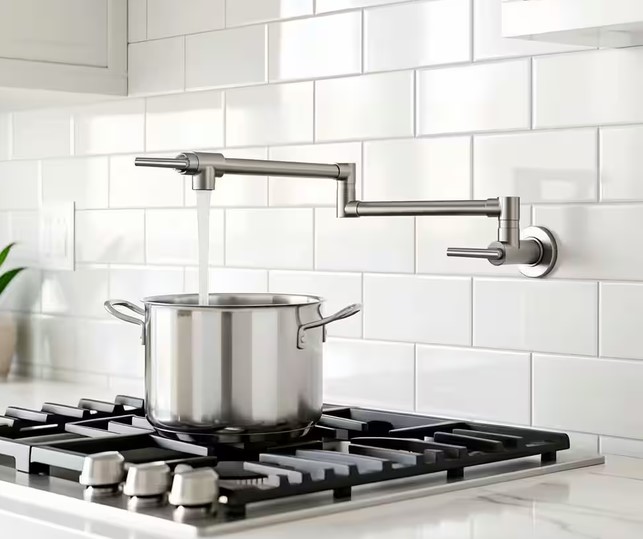
Whenever clients ask me how to truly elevate their cooking workspace to professional standards, my answer always starts at the plumbing rough-in phase with a single, articulating luxury fixture: the wall-mounted pot filler.
Ergonomic Flow: The Architectural Logic of Source-Side Plumbing
To understand why this specific fixture is a necessity rather than a luxury, we have to analyze modern kitchen ergonomics. Traditional architecture forces the main sink area to handle two entirely different tasks: fluid sourcing and waste clearing.
The Highway Bottleneck Analogy
Think of your kitchen workflow as a busy city highway during rush hour. Your main sink is a major intersection where food preparation, dishwashing, hand cleaning, and water sourcing all converge at the exact same time.
When you force a massive stockpot into that main sink intersection, you completely block the traffic flow of the entire kitchen.
By installing a dedicated pot filler directly above the cooking surface, you create a specialized bypass lane. You decouple water sourcing from the cleanup zone, allowing one person to manage high-volume boiling tasks at the range while another handles prep work at the basin without stepping on each other’s toes.
Technical Foundations: Anatomy of a Commercial-Grade Extension
A professional-grade pot filler is an impressive piece of plumbing engineering. Unlike a standard pull-out spray faucet, this fixture is built specifically to deliver high volumes of water rapidly while folding completely flat against the backsplash wall when not in use.
-
Articulating Jointed Arms: Built with dual or triple swing joints, allowing the spout to extend up to 26 inches out from the wall to reach the center of any burner on a large commercial range top.
-
Dual-Shutoff Valve System: Engineered with two separate mechanical valves—one at the wall base and one at the tip of the spout. This layout provides an ironclad safety backup to prevent accidental leaks over an active, hot stove.
-
High Flow-Rate Aerators: While standard kitchen faucets are legally restricted to low flow rates (typically around 1.5 to 1.8 gallons per minute), a dedicated commercial unit bypasses these restrictions, often delivering 2.5 to 4.0 gallons per minute (GPM) to fill massive vessels in seconds.
Step-by-Step Guide to a Flawless Structural Rough-In
Integrating this fixture requires careful coordination during the plumbing infrastructure phase. Here is the exact technical blueprint I use on the job site to ensure long-term stability.
-
Step 1: Determine the Absolute Height: Measure your largest stockpot sitting on top of your tallest stove grate. You want the bottom of the faucet spout to sit precisely 3 to 4 inches higher than that lip to allow for easy vessel clearance.
-
Step 2: Anchor the Supply Line to Framing: Do not simply run a loose copper pipe through the drywall. Secure a heavy-duty brass drop-ear elbow directly into a horizontal wooden blocking support anchored firmly between the wall studs. This prevents the heavy metal arm from sagging or shaking when extended.
-
Step 3: Run a Cold-Water Line Only: Because this water is used exclusively for cooking and boiling, run a dedicated, high-pressure cold-water line using PEX or copper piping straight to the anchor point.
 [Vertical Wall Stud] ◄═══► [Horizontal Wood Block] ◄═══► [Vertical Wall Stud]
                                    │
                                    ▼
                        [Brass Drop-Ear Elbow]
                                    │
                                    ▼
                        [Threaded Nipple Outlet]
                                    │
                                    ▼
                        [Articulating Faucet Body]
Material Performance for High-Moisture Ranges
| Faucet Core Material | Structural Longevity | Corrosion Resistance | Finish Options |
| Solid Lead-Free Brass | Excellent (Lifetime structural integrity) | Exceptionally High | Matte Black, Brushed Gold, Polished Chrome |
| 304 Stainless Steel | High (Highly resistant to physical dents) | High | Industrial Brushed Steel |
| Zinc Alloy / Plastic Cores | Poor (Prone to joint cracking under heat) | Low | Basic Chrome (Budget-friendly) |
Expert Advice for Long-Term Structural Safety
💡 Pro Tip: The Hidden Shut-Off Trap
Throughout my decade in home improvement, the most critical mistake I see intermediate DIYers make is failing to plan for structural maintenance. Because a pot filler sits directly over an expensive electronic range top, any microscopic drip can ruin your cooking appliance. Always install an easily accessible, dedicated shut-off ball valve in an adjacent lower cabinet or basement line leading to the fixture. When you leave for vacation, shut off the water to the range faucet completely at the source to guarantee absolute peace of mind against pressure surges.
Streamlining Your Culinary Sanctuary
Upgrading your cooking space with a commercial-grade pot filler is far more than a statement of luxury; it is a fundamental commitment to ergonomic efficiency and workplace safety. By bringing the water source directly to your heat source, you optimize your daily kitchen traffic patterns, protect your physical health from heavy lifting injuries, and cut your meal preparation times in half. When you invest in solid brass internal components and secure your rough-in plumbing directly to the house framing, you turn your kitchen into a high-performance sanctuary built to last a lifetime.
Are you currently designing a kitchen remodel, or are you tired of lugging heavy pots across your floor every single evening? What style of range top are you planning to pair with your custom plumbing? Let’s talk kitchen layouts—drop your questions or share your remodeling projects in the comments below!










+ There are no comments
Add yours