




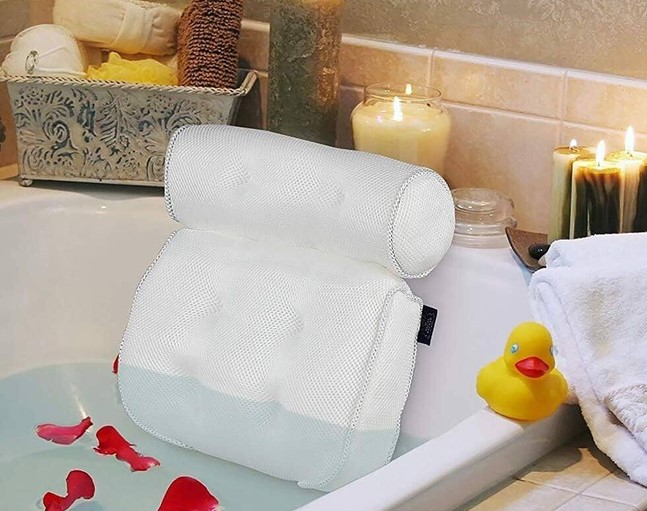
It was a cold Tuesday evening when a client named Sarah called me about a complete bathroom remodel I had finished two weeks prior. She loved the freestanding acrylic soaking tub, the brushed brass fixtures, and the ambient dimmable lighting. But she had one major complaint: “Every time I lean back to relax, my head support slips, and my neck gets slammed against the tub ledge!”
In my more than ten years of renovating residential bathrooms and designing home wellness spaces, I have witnessed this exact frustration dozens of times. Homeowners invest thousands of dollars into high-end hydrotherapy tubs, only to have their relaxation ruined by a simple accessory that refuses to stay put.
The culprit is almost never the pillow cushion itself—it is a fundamental misunderstanding of bath pillow suction. When you master the mechanics of suction adhesion and tub surface physics, you turn a slippery, frustrating headrest into an immovable ergonomic anchor.
The Science of Water and Glass: How Bath Pillow Suction Works
To understand why your bath pillow slips mid-soak, it helps to look at the physics of suction through a practical lens. Think of a suction cup as a tiny atmospheric vacuum pump. When you press the flexible cup flat against a tub wall, you push out the air trapped beneath it, creating a low-pressure vacuum chamber inside the dome.
External atmospheric pressure then presses firmly against the outside of the cup, forcing it against the tub surface with surprising power. However, this mechanical seal relies on one crucial factor: an absolute, airtight interface.
If your tub surface has even microscopic pores, soap residue, or hard water mineral scale, air slowly creeps under the rim. The pressure inside and outside equalizes, atmospheric resistance vanishes, and your pillow slides down the wet wall right into your bathwater.
Evaluating Suction Systems: Materials and Cup Architecture
Not every bath pillow suction assembly is built to withstand the humid, soapy environment of a modern bathtub. In my field inspections, I evaluate bath pillows based on their suction cup hardware, material composition, and distribution points.
1. Pure Silicone vs. Standard PVC Cups
Standard PVC suction cups are cheap, but they harden quickly when exposed to hot water and bath oils over time. High-grade food-grade silicone or Thermoplastic Rubber (TPR) cups retain their elasticity across extreme temperature fluctuations, allowing them to form a tighter, longer-lasting vacuum seal against smooth tub walls.
2. Multi-Point Suction Arrays
Single or dual-cup designs are notoriously unstable because any head movement creates rotational torque that pops the seal. The most reliable bath pillows feature an array of 4 to 7 heavy-duty suction cups strategically placed across the upper neck support and lower back panel to distribute weight evenly.
+--------------------------------------------------------------------+
|                BATH PILLOW SUCTION HARDWARE MATRIX                 |
+--------------------------------------------------------------------+
| Feature            | Standard PVC Cups     | Premium Silicone Cups |
+--------------------------------------------------------------------+
| Heat Resistance    | Moderate (Hardens)    | Excellent (Flexible)  |
| Chemical Resistance| Low (Degrades)        | High (Resists Oils)   |
| Grip Longevity     | 15–30 Minutes         | Hours/Indefinite      |
| Compatibility      | Ultra-Smooth Only     | Smooth & Light Texture|
+--------------------------------------------------------------------+
The Pro Protocol: Achieving Unshakeable Bath Pillow Suction
Installing a bath pillow isn’t as simple as slapping it onto the wall right before you jump in. If you want your headrest to remain rock-solid throughout a 45-minute soak, you must prep both the substrate and the suction cups using this field-tested method:
-
Deep Clean the Substrate: Soap scum, body oils, and bath bomb residue create a slick film that destroys suction. Wipe down the target area on your tub using isopropyl alcohol or a vinegar-water mix, then buff it completely dry with a microfiber towel.
-
Condition the Suction Cups: Clean the inner face of each suction cup to remove lint, hair, and skin oil accumulation.
-
The Micro-Moisture Trick: Never apply suction cups to a bone-dry tub wall, nor should you submerge them entirely in water. Lightly dab a microscopic film of clean water onto the inner rim of each cup—this liquid fills micro-gaps and creates a tight hydraulic seal.
-
Apply Central Pressure: Press firmly on the center of each individual suction cup—not the padded pillow fabric—to expel 100% of the trapped air from the center outward.
Hidden Warning: The Tear-Off TrapNever yank a bath pillow straight off the tub wall by pulling on the mesh fabric or foam cushion! Doing so exerts massive point-tension on the cup attachment points, tearing the suction cups right out of the pillow stitching. Always slide your fingernail or a plastic card under the edge of each individual cup to break the vacuum seal gracefully before removal.
Troubleshooting Common Bath Pillow Suction Failures
Even top-tier accessories can suffer from suction drop-offs if environmental conditions change. Here is how I address the most frequent issues homeowners encounter in the field:
Curved or Angled Tub Backs
Slanted tub walls create angled gravity vectors that pull the top of the pillow forward. To fix this, elevate the lower suction cups slightly higher on the incline to ensure the main load-bearing cups face perpendicular to the wall.
Textured Fiber-Reinforced Plastic (FRP) and Stone Tubs
Suction cups require a non-porous, smooth surface to maintain a vacuum seal. If your tub features textured fiberglass or natural stone tile above the water line, standard bath pillow suction will fail. In these setups, opt for weighted over-the-tub-ledge counterbalanced pillows or apply smooth acrylic adhesive disc pads to create localized mounting plates.
Pro Tip: The Boiling Water Restoration TrickOver months of storage, suction cups can become warped, flattened, or misshapen. Don’t throw the pillow away! Submerge the deformed rubber or silicone cups in boiling water for 2 to 3 minutes. The thermal memory of the material will force the cup back into its original, perfect concave dome shape.
Maintenance Practices for Long-Term Ergonomic Comfort
A bath pillow operates in a warm, moist microclimate—the ideal environment for mildew and bacteria to thrive under suction pads. Maintaining proper hygiene ensures both health safety and strong mechanical suction.
-
Remove and Rinse Weekly: Peel the pillow off the tub wall at least once a week to prevent stagnant water from gathering beneath the suction pads.
-
Hang to Dry: Choose a bath pillow equipped with a built-in hanging hook, and hang it in a well-ventilated area after every soak.
-
Air Mesh Fabric Care: Ensure the suction cups are attached to quick-drying 3D or 4D air mesh fabric, which allows air and water to circulate freely through the cushion matrix rather than trapping moisture inside.
Final Thoughts: Elevate Your Soaking Experience
Upgrading your home wellness amenities doesn’t always require knocking down walls or replacing plumbing fixtures. By understanding the physics of bath pillow suction, choosing resilient silicone hardware, and adhering to proper surface preparation, you can turn any ordinary bathtub into a stable, ergonomic haven.
Are you struggling with a bath pillow that refuses to stay put, or have you discovered a mounting trick that works wonders on your tub? Share your experiences and questions in the comments below—I’d love to help you dial in your ultimate home spa experience!










+ There are no comments
Add yours