






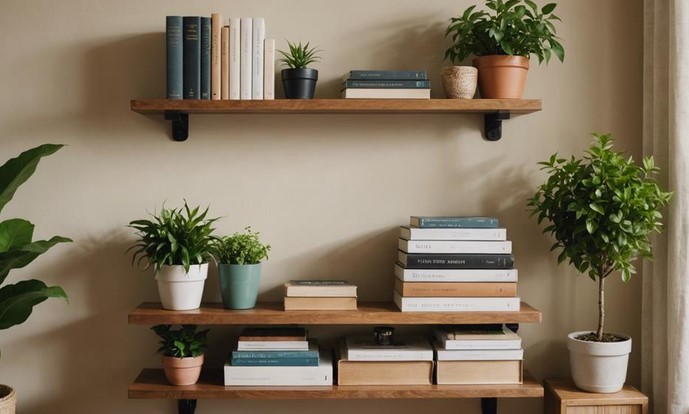
You open the door to your apartment or home office, and the walls instantly feel like they are closing in. Massive, dark wooden bookcases dominate the floor space, making a 120-square-foot room feel like a cramped walk-in closet. Your favorite books are double-stacked, your desk is cluttered, and the entire room feels heavy.
If this layout trap sounds familiar, you are struggling with a modern design crisis: wasting your footprint while leaving your walls completely naked.
Over my ten years as a home improvement expert specializing in urban spatial design, I have walked into hundreds of micro-apartments and compact offices. The most common mistake I see homeowners make is thinking horizontally. They try to crowd more furniture onto the floor, completely forgetting that they own feet of unused vertical real estate above their heads.
My go-to professional solution for instantly multiplying a room’s visual and physical volume is a design favorite: the floating book shelf. When engineered and anchored correctly, this elegant installation goes far beyond simple storage—it is a core tool for true architectural space optimization.
The Physics of Illusion: Why Floating Elements Open Up a Room
To understand why a cantilevered wall unit completely changes the energy of a room, we need to talk about how the human brain perceives square footage.
The Floorboard Analogy
Think of your eyes as a robotic vacuum cleaner patrolling your room. When you walk into a space, your brain automatically tracks the continuous, unbroken line of the floorboards or carpet right up to where they meet the baseboards.
If a heavy bookcase blocks that floor line, your brain registers the room as physically smaller.
By lifting the storage off the ground and mounting a sleek floating book shelf system, you expose the underlying floorboards. This tricks the brain into registering a larger boundary, making the entire room feel immediately brighter, airier, and significantly more spacious.
The Technical Foundations of a Secure Install
A major roadblock for beginners is structural anxiety. I cannot tell you how many times a client has confessed to me, “I love the look, but I’m terrified twenty hardcovers will rip the drywall down.”
Let’s demystify the structural engineering. A floating shelf functions as a cantilevered beam—a structural element anchored at only one end. Because all the gravitational force pushes downward and outward on the wall anchor, your installation is only as strong as its connection to the framing.
Finding the Wall Studs
Never, under any circumstances, rely entirely on plastic drywall anchors to hold a heavy literary collection. You must locate the vertical wood or metal framing members behind the wall, known as studs. In modern residential builds, these are typically spaced precisely 16 inches apart from center to center.
Selecting the Right Concealed Bracket
The secret to the “floating” illusion is a heavy-duty, concealed steel bracket plate featuring protruding metal rods. The shelf itself is custom-bored with deep internal holes that slide directly over these rods, completely hiding the supporting framework within the body of the wood.
Step-by-Step Guide to a Flawless Installation
Achieving professional results requires precision tools and a patient approach. Here is the exact installation sequence I use on the job.
-
Step 1: Locate and Mark the Studs: Use a high-quality electronic stud finder to find the edges and centers of the wall framing. Mark these locations using a carpenter’s pencil.
-
Step 2: Establish a True Level Line: Do not eyeball your heights. Use a long spirit level or a self-leveling laser line to draw a perfectly horizontal reference mark across the wall.
-
Step 3: Secure the Steel Bracket: Position the concealed bracket plate against your level line. Drive heavy-duty lag screws directly through the bracket holes into the center of the wooden studs.
-
Step 4: Mount the Shelf Core: Line up the pre-drilled internal channels of your wooden shelf with the protruding steel support rods. Slide the shelf flush against the drywall surface, ensuring a tight, secure friction fit.
[Drywall Surface] ◄─── [Concealed Steel Plate] ───► [Protruding Rods]
        │                       │                           │
        ▼                       ▼                           ▼
[Lag Screw into Stud]   [Hidden Behind Wood]     [Slides Inside Bored Shelf]
Material Assessment for Vertical Storage
| Shelf Material | Load-Bearing Capacity | Warp Resistance | Aesthetics & Style |
| Solid Hardwood (Oak, Walnut) | Excellent (Up to 50 lbs per stud connection) | High | Premium, rich natural grain texture |
| High-Density MDF | Moderate (30–40 lbs max) | Moderate (Sags under long-term dampness) | Smooth, ideal for sleek painted finishes |
| Hollow-Core Particle Board | Poor (10–15 lbs maximum) | Low (Prone to structural bowing) | Budget-friendly, lightweight |
Expert Advice for Long-Term Structural Safety
💡 Pro Tip: The Hidden “Moment Arm” Leverage Trap
Throughout my decade in home improvement, the most common mistake I see intermediate DIYers make is failing to understand the physics of depth. In structural mechanics, the deeper your shelf is, the greater the rotational leverage (or moment arm) exerted on the wall bracket. If you install a deep 12-inch shelf and pack heavy encyclopedias at the very outer edge, you multiply the pulling force on the top wall screws. Keep your floating book shelf depth between 8 to 10 inches max for books, and always push the heaviest items all the way to the back against the wall.
Elevating Your Home’s Spatial Architecture
Maximizing your verticality with a well-placed floating book shelf layout is about much more than just sorting out clutter. It is a smart design strategy that reclaims wasted air space, keeps your floor layout wide open, and adds clean architectural lines to your interior. By taking the time to properly locate your wall studs, selecting a high-density wood core, and utilizing professional-grade hidden brackets, you can confidently turn any bare wall into a beautiful, weight-defying library that makes your room feel twice its size.
Are you ready to swap out a bulky bookcase for a sleek vertical layout this weekend? What room in your home could benefit the most from a spatial transformation? Let’s talk layout strategy—drop your questions or share your installation projects in the comments below!











+ There are no comments
Add yours